
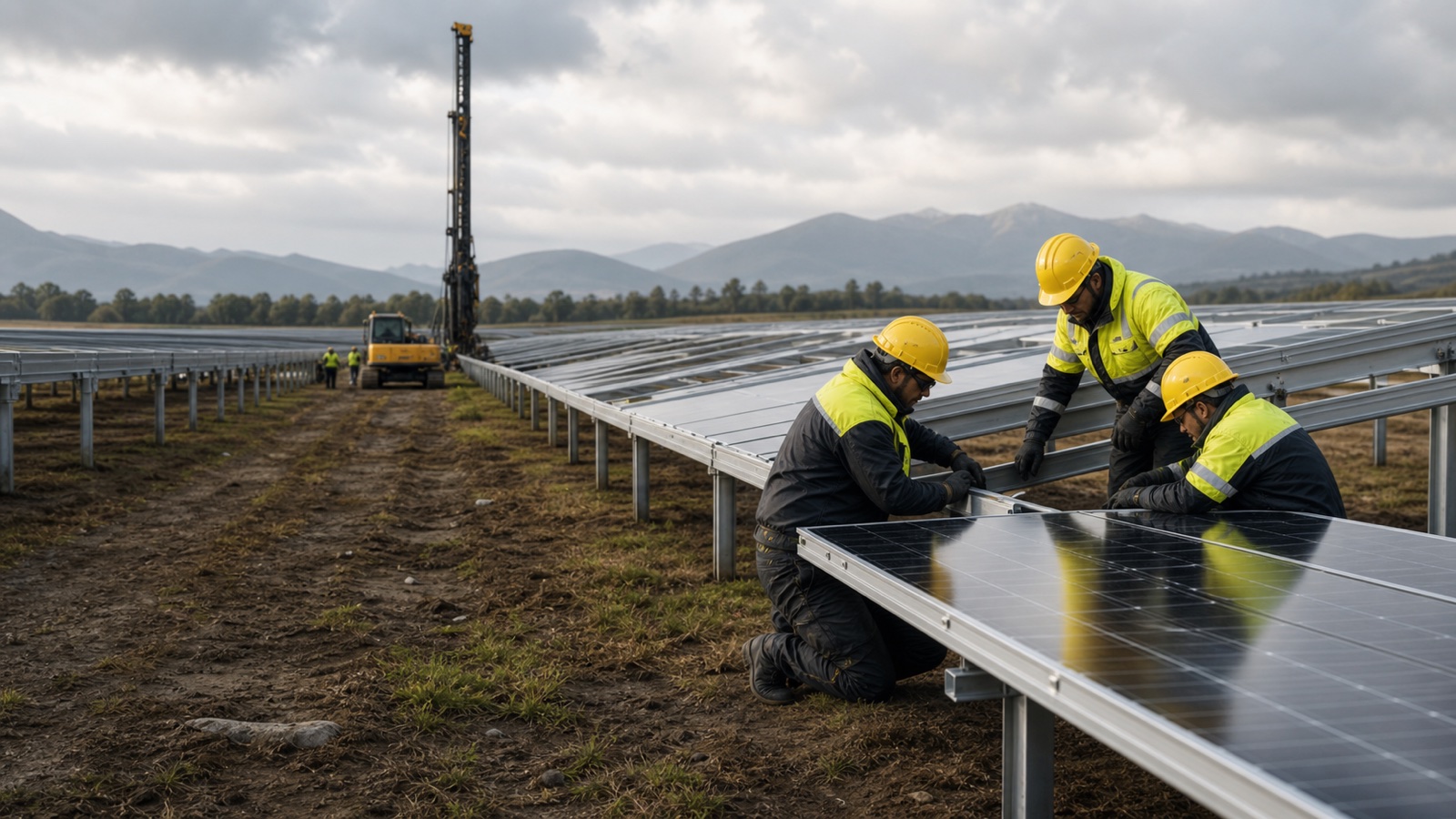
Nemesis Solar completed its first pilot utility-scale project in Sweden as a subcontractor to the general contractor: the installation and commissioning of a 30 MW solar power plant. The assignment combined mechanical construction, electrical works and commissioning. The defining site challenge was rocky ground, which prevented part of the driven piles from reaching the specified design depth.
Project role and scope
Our team carried out the works under the direction of the general contractor. The mechanical package included assembly and installation of the supporting structures and mounting of the photovoltaic modules.
The electrical scope covered cable installation, the earthing system, protective corrugated conduit, and installation and connection of inverter equipment. During commissioning, the team performed inspections, measurements and verification of electrical circuit parameters.
The challenge: piles meeting rock before design depth
The principal technical constraint was the stony ground. Standard driving could not bring every pile to the design depth. Treating all refused piles in the same way would have ignored their actual load-bearing performance and created unnecessary rework.
The project therefore required a controlled decision process: verify capacity first, then select the corrective action from measured results rather than visual judgement alone.
Step 1 — pull-out testing
Control pull-out tests were performed on affected piles. The tests checked whether a pile that stopped above the intended depth still satisfied the required bearing-capacity criteria.
This separated piles that were structurally acceptable from those requiring reinforcement. Test results created an objective basis for the next operation and maintained traceability for quality control.
Step 2 — trimming accepted piles
Piles that passed the specified capacity requirements were cut to the project level. This allowed the mounting structure to retain the required geometry without replacing a pile that had already demonstrated adequate performance.
The sequence connected structural verification with practical installation: test, accept, trim and release for mechanical assembly.
Step 3 — additional concrete reinforcement
Where a pile did not pass the control test, its base received additional concrete reinforcement. The corrective measure addressed insufficient verified capacity while allowing work to continue under the approved project requirements.
By using two result-based routes—trimming after a successful test or reinforcement after an unsuccessful one—the team adapted the installation to variable ground conditions without abandoning quality control.
A complete delivery across three disciplines
The Swedish project demonstrated our ability to coordinate mechanical installation, electrical works and commissioning within one subcontract package. It also established a practical method for responding to difficult ground: measure actual performance, document the decision and apply the appropriate engineered correction.
For Nemesis Solar, the 30 MW plant became an important first utility-scale reference in Sweden and practical confirmation that the team can solve site problems while maintaining programme and installation quality.
/ FAQ
What was Nemesis Solar’s role in the project?
Nemesis Solar worked as a subcontractor to the general contractor and carried out mechanical installation, electrical works, measurements and commissioning activities within the assigned scope.
How were piles that could not reach design depth handled?
Affected piles were pull-out tested. Piles meeting the required capacity were trimmed to project level; piles that failed the test received additional concrete reinforcement at the base.